Gujarat’s New Education Policy 2026: Holistic Progress Cards to Replace Pass-Fail System from Classes 1 to 8
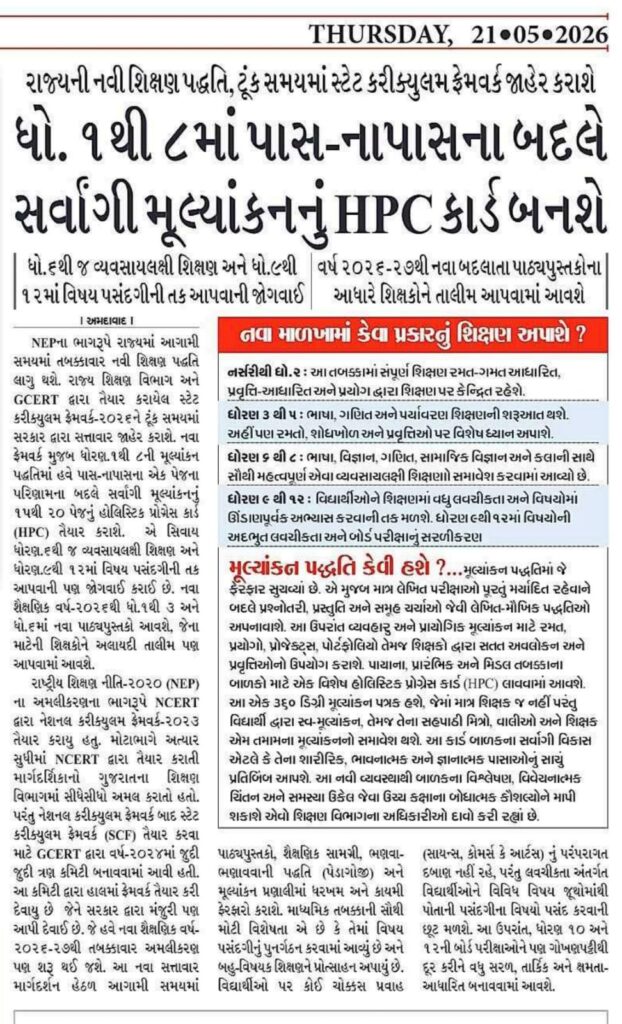
The education system in Gujarat is preparing for one of the biggest transformations in recent years. Under the implementation of the National Education Policy (NEP) 2020, the traditional “pass or fail” system for students from Classes 1 to 8 will gradually be replaced by a modern and comprehensive assessment model known as the Holistic Progress Card (HPC).
This new evaluation method is expected to bring a major shift in how students are taught, assessed, and guided in schools across the state. Instead of focusing only on marks and exam results, the Holistic Progress Card aims to measure the complete development of a child — including academic learning, creativity, practical skills, emotional growth, communication, and problem-solving abilities.
The Gujarat Council of Educational Research and Training (GCERT), along with the State Education Department, is working on implementing the State Curriculum Framework (SCF) in phases from the academic year 2026–27. This move aligns Gujarat’s education structure with the broader vision of NEP 2020 introduced by the Government of India.
In this article, we will explore the new education policy in Gujarat, the concept of the Holistic Progress Card, changes in assessment patterns, the role of teachers, benefits for students, challenges in implementation, and what parents and schools should expect in the coming years.
What is the Holistic Progress Card (HPC)?
The Holistic Progress Card (HPC) is a modern evaluation framework introduced under the National Education Policy 2020. Unlike traditional report cards that mainly display exam marks and ranks, the HPC focuses on the overall development of a student.
The card is designed to evaluate students in multiple areas, such as:
- Academic performance
- Critical thinking
- Creativity
- Communication skills
- Practical learning
- Emotional and social development
- Sports and extracurricular activities
- Participation and teamwork
- Ethical and moral values
The idea behind the Holistic Progress Card is simple: every child is unique, and education should not judge students only through written examinations.
Instead of labeling children as “pass” or “fail,” the new system will monitor their learning journey and encourage continuous improvement.
Why Gujarat is Introducing This New System
The existing education system has often been criticized for putting excessive pressure on students through examinations and marks. Many experts believe that rote learning and memorization have limited students’ creativity and real-world skills.
The National Education Policy 2020 recommends a complete transformation in teaching and assessment methods. Gujarat has now started implementing these reforms in schools.
The main objectives behind introducing the Holistic Progress Card include:
1. Reducing Exam Pressure
Young students often experience stress and anxiety because of exams. The new system aims to create a healthier learning environment.
2. Encouraging Skill-Based Learning
Instead of memorizing textbook answers, students will learn through activities, experiments, projects, and practical experiences.
3. Promoting Overall Development
Education will focus on intellectual, emotional, social, and physical growth.
4. Supporting Individual Learning Styles
Every child learns differently. The new framework will help teachers understand each student’s strengths and weaknesses.
5. Preparing Students for the Future
Modern careers require creativity, communication, collaboration, and critical thinking. The new system aims to build these abilities from an early age.
Major Changes in Gujarat’s Education System
The upcoming reforms are expected to significantly change classroom teaching, curriculum design, and evaluation methods.
Here are the key highlights:
1. No Traditional Pass-Fail System for Classes 1 to 8
One of the biggest changes is the removal of the conventional pass-fail model for primary and upper primary students.
Instead of simply declaring students as “passed” or “failed,” schools will provide detailed feedback about:
- Learning progress
- Subject understanding
- Participation
- Skills development
- Behavioral growth
- Creativity and innovation
This approach is expected to reduce fear among children and create a more supportive educational atmosphere.
2. Continuous and Comprehensive Evaluation
Assessment will no longer depend only on annual examinations.
Students will be evaluated throughout the year through:
- Classroom activities
- Assignments
- Group discussions
- Projects
- Presentations
- Practical work
- Observation by teachers
This method ensures that learning becomes a continuous process rather than an exam-centered system.
3. Activity-Based Learning
The new curriculum framework promotes experiential learning.
Children will learn concepts through:
- Experiments
- Storytelling
- Role-play
- Games
- Art integration
- Field activities
This makes education more engaging and easier to understand.
4. Vocational Education from Early Classes
According to NEP 2020, vocational and skill-based learning will become an important part of school education.
Students may get exposure to:
- Agriculture
- Carpentry
- Coding
- Handicrafts
- Entrepreneurship
- Local arts and crafts
This helps students develop practical skills and career awareness from a young age.
5. Focus on Foundational Literacy and Numeracy
Special attention will be given to ensuring that children develop strong reading, writing, and mathematical skills in the early years.
This is considered one of the most important goals under NEP 2020.
How the Holistic Progress Card Will Work
The Holistic Progress Card is expected to provide a 360-degree assessment of students.
Instead of a simple marksheet, the HPC may include:
| Assessment Area | Description |
|---|---|
| Academic Skills | Understanding of subjects and concepts |
| Cognitive Skills | Problem-solving and critical thinking |
| Social Skills | Teamwork and communication |
| Emotional Development | Confidence and emotional stability |
| Physical Development | Participation in sports and fitness |
| Creative Expression | Art, music, drama, innovation |
| Practical Learning | Hands-on activities and projects |
Teachers may use observations, rubrics, assignments, and interactions to prepare the report.
Role of Teachers in the New Education Framework
Teachers will play a much bigger role in the success of this system.
Instead of only conducting lectures and exams, teachers will become:
- Mentors
- Facilitators
- Skill guides
- Observers
- Counselors
The government is also expected to provide special training programs for teachers so they can adapt to:
- New teaching methodologies
- Digital learning tools
- Student-centered classrooms
- Modern assessment techniques
Teacher training will be crucial because the Holistic Progress Card requires continuous observation and detailed student feedback.
Changes in Curriculum Under State Curriculum Framework (SCF)
The State Curriculum Framework (SCF) being prepared by GCERT will align with the National Curriculum Framework developed by NCERT.
The curriculum will focus on:
Foundational Stage
- Play-based learning
- Activity-oriented teaching
- Language development
- Social interaction
Preparatory Stage
- Reading and writing skills
- Basic mathematics
- Environmental awareness
- Creativity
Middle Stage
- Subject-oriented learning
- Scientific thinking
- Logical reasoning
- Vocational exposure
Secondary Stage
- Flexibility in subject choices
- Multidisciplinary learning
- Career-focused education
Benefits of the Holistic Progress Card System
The new evaluation method can offer several long-term benefits.
1. Reduced Stress Among Students
Children will no longer fear failure in the traditional sense.
This may improve mental health and classroom confidence.
2. Better Understanding of Student Potential
The system identifies strengths beyond academics.
A student good at sports, music, communication, or leadership can also receive recognition.
3. Encourages Practical Learning
Students will focus more on understanding concepts rather than memorizing answers.
4. Improved Teacher-Student Relationship
Teachers will observe students more closely and guide them individually.
5. Promotes Creativity and Innovation
Project-based learning encourages students to think independently.
6. Equal Importance to Skills and Academics
The education system will value life skills and personality development alongside exam performance.
Challenges in Implementing the New System
Although the new education model has many advantages, implementation may also face challenges.
1. Teacher Training Requirements
Teachers need proper training to handle continuous evaluation methods effectively.
2. Increased Workload
Preparing detailed progress reports for every student may increase teachers’ responsibilities.
3. Infrastructure Gaps
Some schools, especially in rural areas, may lack resources for activity-based and digital learning.
4. Parent Awareness
Many parents are still used to marks-based education systems.
Awareness programs will be necessary to explain the benefits of holistic assessment.
5. Standardization Difficulties
Maintaining uniform evaluation standards across thousands of schools could be challenging.
How Parents Should Prepare
Parents also have an important role in adapting to the new education system.
Here are some suggestions:
- Focus on learning rather than marks
- Encourage curiosity and creativity
- Avoid comparing children with others
- Support extracurricular activities
- Communicate regularly with teachers
- Help children build confidence
The new system requires a collaborative approach involving schools, teachers, parents, and students.
Digital and Technology Integration
The future education framework is expected to include greater use of technology.
Schools may increasingly adopt:
- Smart classrooms
- Digital assignments
- Educational apps
- Online assessments
- Interactive learning platforms
Technology can help teachers track student progress more efficiently under the Holistic Progress Card system.
Vocational Education and Future Career Readiness
One of the strongest aspects of the NEP-based reforms is the emphasis on employability and practical skills.
Students will gradually become familiar with real-world applications and career pathways.
This may help reduce the gap between education and employment in the future.
Impact on Rural Schools in Gujarat
The implementation of the Holistic Progress Card system in rural areas will be especially important.
Government support may focus on:
- Teacher training
- Digital infrastructure
- Learning resources
- Skill-based education programs
If implemented effectively, the new policy can improve educational quality in remote areas as well.
What Experts Say About the New Policy
Education experts generally support the shift toward holistic assessment.
According to academic researchers, traditional examinations often fail to measure:
- Creativity
- Communication abilities
- Leadership skills
- Emotional intelligence
The new approach aims to create well-rounded individuals instead of only high-scoring students.
However, experts also stress that successful implementation depends heavily on:
- Teacher preparedness
- School infrastructure
- Parent cooperation
- Administrative support
Timeline of Implementation in Gujarat
As per reports, the implementation of the new curriculum and evaluation system is expected to happen in phases starting from the academic year 2026–27.
Different stages of education may gradually adopt:
- Revised textbooks
- New learning methods
- Holistic assessment practices
- Updated curriculum structures
The transition may take a few years for complete statewide implementation.
Future of School Education in India
The reforms in Gujarat reflect a larger national transformation under NEP 2020.
India’s future education system is expected to become:
- More flexible
- Skill-oriented
- Student-centered
- Technology-driven
- Multidisciplinary
The focus is shifting from memorization to meaningful learning.
This change could significantly impact how future generations think, learn, and work.
Conclusion
Gujarat’s decision to introduce the Holistic Progress Card system for Classes 1 to 8 marks a major turning point in school education. By moving away from the traditional pass-fail structure, the state aims to create a more balanced, student-friendly, and future-ready education model.
The new framework emphasizes continuous learning, creativity, practical skills, emotional development, and overall personality growth. While challenges such as teacher training and infrastructure development remain, the long-term vision is promising.
If implemented successfully, the Holistic Progress Card system could transform classrooms into spaces where children learn without fear and develop the skills needed for the modern world.
The coming years will determine how effectively Gujarat can turn this ambitious educational reform into reality, but one thing is clear — the focus of education is now shifting from marks to meaningful learning and holistic development.